Recently, I’ve noticed I sit down at my laptop and sense a heaviness before I've even opened a single tab. Why? Because there are already too many tabs open. Too many projects being juggled. Too many avenues to take, too much to do, and not enough time. So — where to begin today?
Ready TO TEND TO YOUR OWN SPARK, ONE STEP AT A TIME? Check out the RESET toolkit:
I don't think this is just a me problem. Maybe yours isn't a laptop screen full of tabs. Maybe it's the renovation you won't start until you've priced every stage. The course you won't launch until the whole curriculum is mapped. The hard conversation you keep rehearsing all the way through to an ending you can't actually predict. We tell ourselves we're being responsible, thorough, sensible. Often what we're really doing is refusing to move until the whole path is lit — and then feeling stuck, not because we lack the next step, but because we're demanding all of them at once.
Why we think we need the whole map
Most of us were taught that good planning means seeing the whole road: the five-year plan, the fully costed renovation, the end product before the prototype. There's a kind of safety in that story — if you can see every step, nothing can surprise you. So the instinct, when something matters to us, is to try to eliminate the not-knowing entirely before we'll allow ourselves to begin.
But that instinct isn't protecting us. It's usually what's keeping us still.
What's actually happening when we demand the whole path
Researchers who study anxiety have a name for the thing driving that heaviness: intolerance of uncertainty. Psychologists Michel Dugas and Robert Ladouceur, who've spent decades studying chronic worry, found that it isn't uncertainty itself that fuels anxious spiralling — it's our reaction to it. People with a low tolerance for not-knowing treat an unclear future as inherently threatening, something to be resolved through more thinking, more planning, more scenarios worked out in advance. The trouble is, the future doesn't cooperate. There's always another "but what if," so the planning never actually finishes — it just loops, and the loop itself becomes exhausting in a way that has nothing to do with the task at hand.
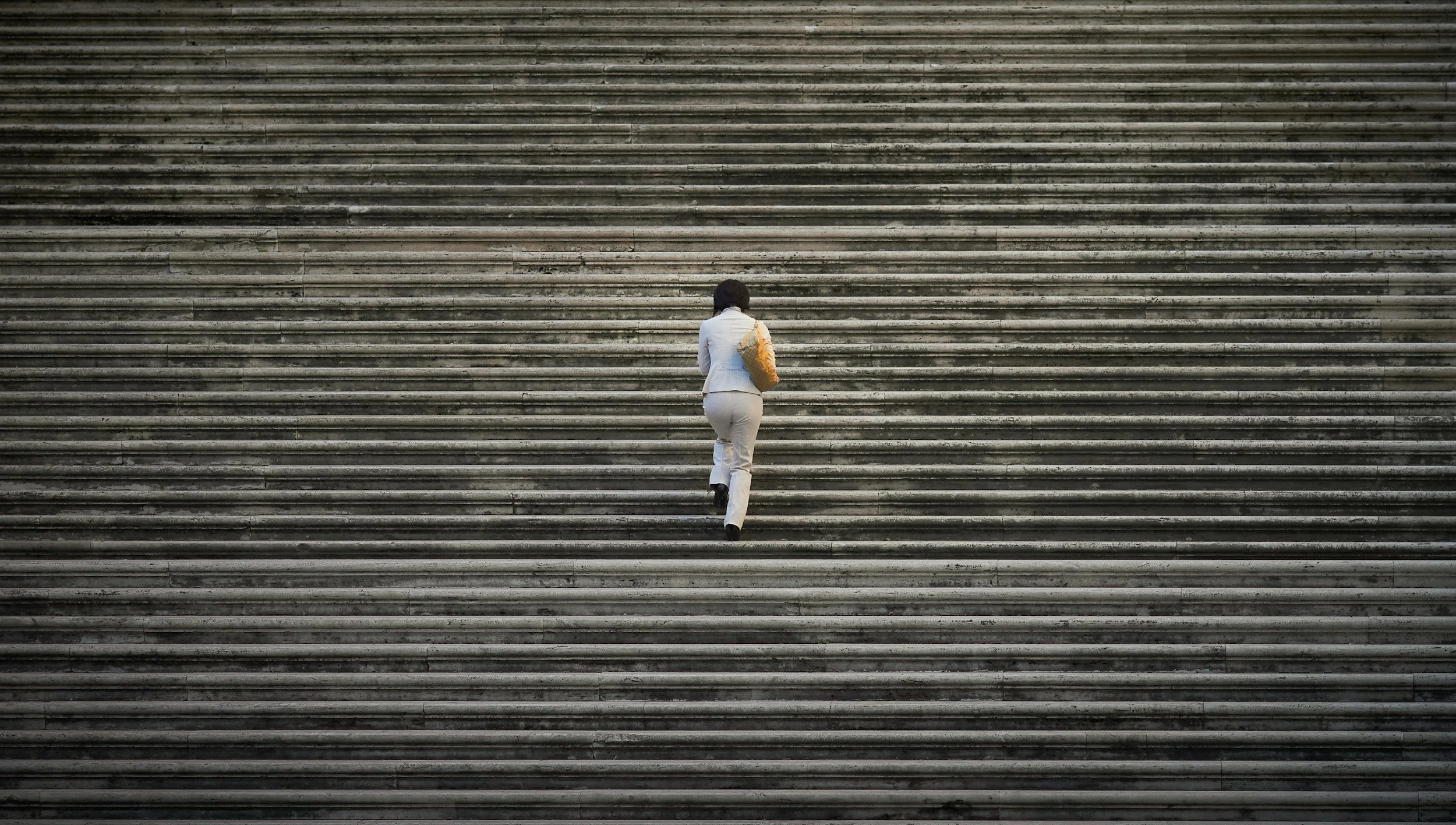
There's a second, more hopeful body of research that points to the way out. Psychologist Peter Gollwitzer spent years studying what actually predicts whether people follow through on a goal, and found something almost embarrassingly simple: a specific, single next action — framed as "when X happens, I will do Y" — outperforms a detailed, ambitious plan almost every time. Not because the big plan is wrong, but because our minds handle one concrete, doable thing far better than they handle ten abstract, contingent ones held in the air at once. The whole staircase overwhelms us… the next step never does.
Put those two findings together and the pattern gets clearer: trying to resolve the whole future in advance doesn't make us more prepared. It mostly makes us more anxious and no closer to moving. One visible, doable step does what ten imagined ones can't.
The resistance: "But what if I take the wrong first step?"
I understand this one, because it's the argument I make to myself too. If I don't know where this leads, how do I know I'm even heading the right way? Where am I supposed to start?
Here's the reframe that finally landed for me: you don't need certainty about the destination to trust the next step. You need the next step to be honest — the truest, most useful thing you can do with what you know right now — and you need to trust that doing it will show you something you couldn't have seen from behind all those open tabs. Behavioural research on motivation backs this up: action tends to come before motivation and clarity, not after. We don't think our way into feeling ready. We take one step, and the readiness catches up from behind.
Taking the one step instead of the ten
Name the single next action, not the project. Not "build the business" — the one email, the one call, the one form you'll actually open today. If you can't picture doing it this afternoon, it's still a destination, not a step.
Use Gollwitzer's format to make it concrete. "When I sit down with my coffee tomorrow, I will send that one email" is better than "I should really reach out to more clients" every time. Specificity is what turns an intention into something your body can actually do.
Cap your planning horizon on purpose. Ask what's truly needed for this week only, not this entire year. You're allowed to genuinely not know what October looks like yet. That's not a gap in your plan. That's just where the road is right now.
Let momentum be your evidence, not certainty. You'll know you're on a good path not because you can see the whole of it, but because taking one step made the next one slightly more visible than it was before.
Notice the ten-step spiral, and gently come back to one. When you catch yourself three "if this, then that"s deep into a future that hasn't happened yet, that's not a planning session — it's the loop Dugas and Ladouceur described. Naming it ("there's the spiral again") is often enough to loosen its grip and bring you back to a single step.
REMEMBER THIS -
You don't need to see the whole road ahead. You just need to trust that the next honest step will show you where to put your foot after that — the way headlights on a dark road only ever show you the next stretch, and somehow that's always been enough to get you the whole way home.
I'd love to know: what's the one step you've been avoiding by trying to plan your way around it instead? Come tell me in the comments below …