Meditation on Flames: What Watching a Candle Taught Me About Attention
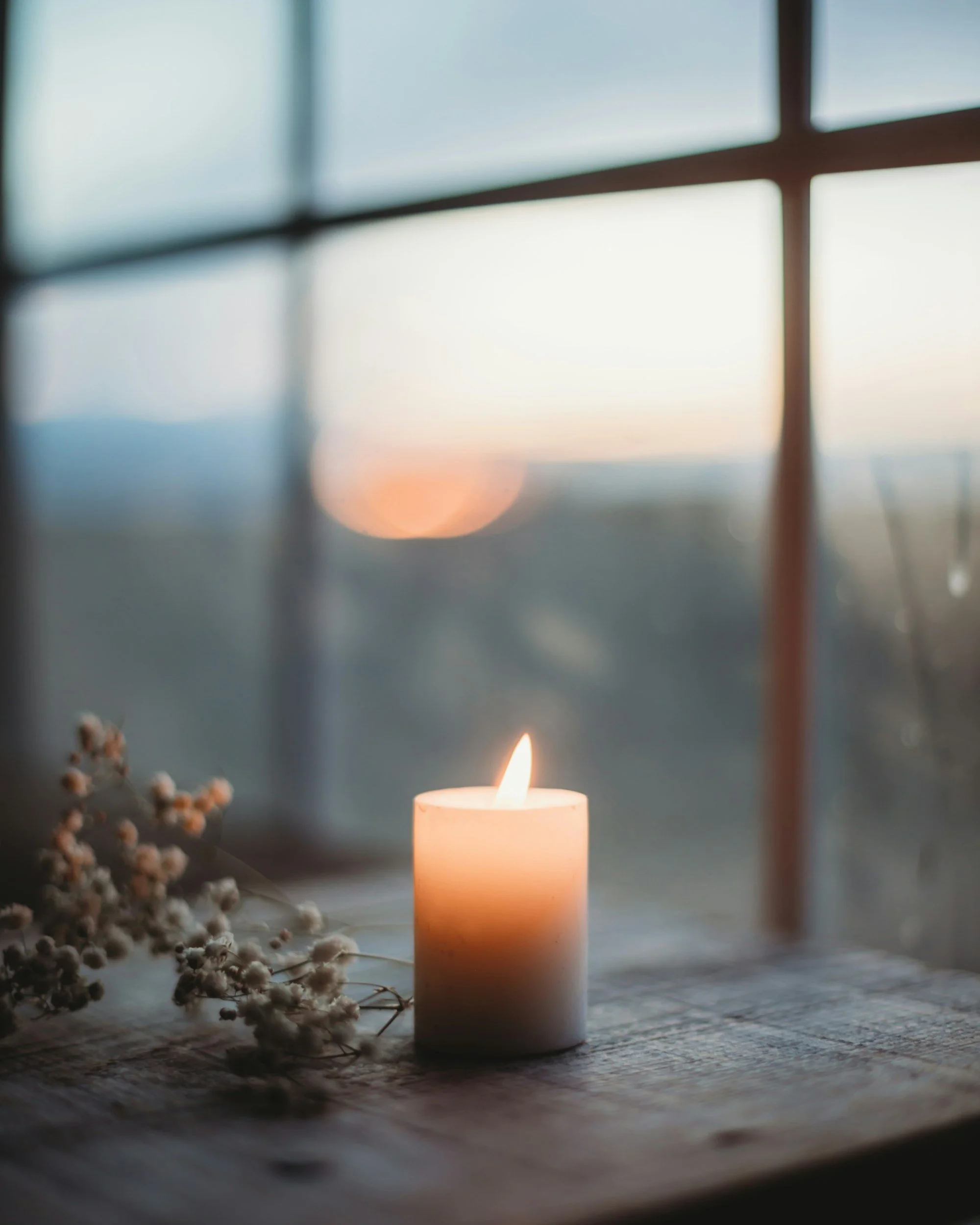
Focus on the flickering of a flame, and nothing else. I learned this particular practice sitting cross-legged on the floor during my meditation teacher training with a single candle in front of me. My teacher’s directions were almost laughably simple: watch the flame, don't blink, see what happens. I remember feeling a little silly - surely there’s something more to master here? Then my eyes started to water within a minute, and something in my chest, which had been clenched for who knows how long, loosened without my permission.
What I'd been handed that day has a name, and a few thousand years of practice behind it: trataka, the yogic art of gazing.
Ready for a recharge? Check out the RESET toolkit:
An ancient technique for a very modern problem
Trataka comes from Hatha Yoga, one of the traditional shatkarmas, or cleansing practices. The instruction is almost embarrassingly simple: fix your gaze steadily on a single point — traditionally a candle flame — without blinking, until your eyes begin to water. That's it. No app, no soundtrack, no seven-step process. Just you, a flame, and the discipline of not looking away.
If that sounds too basic to matter, I understand the skepticism because I had it too. But the appeal of trataka isn't its complexity, in fact it's the opposite. In a life built on split attention, the practice asks for something we almost never give anything anymore: one object, fully looked at, for longer than feels comfortable.
You know the feeling of "watching" a show while also holding a phone, half-present for a conversation while drafting tomorrow's to-do list in your head, reading the same paragraph four times because your eyes are moving but your attention left the room. Most of us haven't looked at any one thing, uninterrupted, in longer than we'd like to admit. Placing our undivided attention on a fixed flame feels too simple and slow when there’s always so much more to do, see and scroll through.
What the research says
A study published in the International Journal of Yoga by researchers Talwadkar, Jagannathan, and Raghuram had 60 elderly adults practice trataka for 26 days. Compared to a wait-list control group, the trataka group showed measurable gains in working memory and attention, tested with tools like the digit span and trail-making tests. This wasn't a subjective "I felt calmer" self-report — it was a change in performance on standardized cognitive tasks.
A systematic review in the Journal of Neurosciences in Rural Practice proposes a mechanism for why: sustained gaze fixation appears to strengthen the prefrontal cortex's top-down attentional networks, while also sharpening what's called thalamic filtering — the brain's ability to screen out irrelevant sensory noise so it can stay locked on one thing. In plain terms, trataka may be a kind of resistance training for your attention span, in an environment engineered to fragment it.
Separately, research on the practice has found associated decreases in blood pressure and pulse rate, markers of a nervous system shifting out of high alert — which tracks with what I felt in my chest on that studio floor.
Fire as teacher
There's something the flickering flame itself seems to know that we've forgotten. It doesn't hold still, and yet it doesn't scatter either. It moves entirely within its own small point, responding to a draft in the room without losing itself. Maybe that's the real lesson trataka offers, underneath the eye strain and the working-memory gains: attention doesn't have to mean rigidity. Mindfulness in motion. You can be fully with one thing and still be alive, still responsive, still moving — as long as you don't look away.
What winter keeps teaching me
It's winter here now, and my instinct every year around this time is the same: make the house warmer, cozier, slower. Thicker blankets on the couch, the lamps instead of the overhead light, a candle lit not for any occasion but just because the evenings are long and I want the room to feel like somewhere I want to snuggle up. Danes have a word for this — hygge — defined by the Oxford English Dictionary as a quality of coziness and comfortable conviviality that produces a feeling of contentment. Denmark's Happiness Research Institute has spent years studying it, and their findings keep pointing to the same ingredients: presence, warmth, slowing down.
What I've noticed is that hygge and trataka keep finding each other without my planning it. I light a candle to make the living room feel cozy, and there it is again — the same small flame that's asking, quietly, to be actually looked at. Winter doesn't just give me permission to slow down. It hands me the exact object I need to practice with, already lit, already on the table. I don't have to carve out separate time for trataka during these months. I just have to notice the candle I already lit for coziness, and let my gaze actually land on it instead of past it and onto a screen or something else. I love to buy wood wick candles for the bigger flames and the extra cozy crackle they give.
Some of my favorite versions of this practice haven't been indoors at all. We love to adventure in our caravan as often as we can, and on those trips I've sat in front of a firepit under an open sky full of stars, gaze settled on the flames while everything else went quiet. After buying firewood and collecting some extra sticks with the kids, we’ll light a fire and watch it sway, crackle, glow. There’s warmth, presence and a primal sense of reflection takes over as you pick a flame to follow, slowly being hypnotised by its fiery dance.
How to try it
You don't need a shrine or forty-five minutes. Ten minutes is plenty to start.
Find a flame — any flame will do. A few ways in, from simplest to most immersive:
A candle (ideally at eye level) about arm's length away, in a room with no draft. The classic version, and the easiest to start with. I love to use wood wick candles!
A birthday candle, if that's what's in the drawer. Its smaller, flickerier flame actually makes it easier to notice the fine movement trataka asks you to watch.
A bonfire or firepit, if you have one. Sitting a comfortable distance back and letting your gaze settle on one point in the flames — not the whole fire — turns an evening outside into the practice without it feeling like a practice.
A youtube video if nothing else is available. It's not a perfect substitute — no real heat, no real flicker of air currents — but a slow, high-quality flame or log fire video (found on youtube) with the crackling sounds turned up, can still give your attention a single point to land on when a real flame isn't available or practical. Better than not trying it at all, and still provides that relaxing vibe!
Sit comfortably and let your gaze land on the tip of the flame. Not the glow around it — the small blue-white point at its base.
Let yourself not blink for as long as it's comfortable. Your eyes will likely water. That's expected, not a sign you're doing it wrong.
When you do need to blink or your eyes tire, close them and let the afterimage of the flame stay in your mind's eye for a few breaths before opening again.
Start with two to five minutes. Trataka is one of those practices where consistency matters more than duration — a few minutes most days will do more than one long session.
If open flames aren't available or safe where you are (small kids, pets, no ventilation), a single fixed point — a dot on the wall, a small object — offers a gentler version of the same practice.
The reframe
We tend to think of focus as something we need more discipline to achieve — another habit to optimise, another app to install. Trataka suggests something quieter: that attention is less a skill you build from scratch and more a muscle you've simply stopped using, because everything around you keeps offering an easier place to look.
The flame doesn't ask you to concentrate harder. It just asks you to stay with it.
Are you going to give a fire-gazing trataka meditation a go? Let me know in the comments below: