The most powerful supercomputer isn't artificial—it's your unconscious mind.
I found myself standing in my kitchen with the fridge door open, no memory of walking there, no idea what I'd come for. My body had made the trip, I hadn't.
That gap between what your brain is doing and what you're actually aware of isn't a glitch. It's a feature — the one that makes you you. And guess what? It's smarter than any AI ever built.
Ready for a recharge? Check out the RESET toolkit below
The number that changes how you see your own mind
Here's the figure that stopped me in my tracks the first time I read it: your senses feed your brain roughly 11 million bits of information every single second. Your eyes alone are pulling in something like 10 million bits a second just from what's in front of you right now—light, color, movement, shape.
And how much of that reaches your conscious awareness, the part of you reading this sentence? Somewhere between 10 and 60 bits per second. Psychologist Timothy Wilson laid this out in Strangers to Ourselves, building on earlier work popularised by Thor Nørretranders in The User Illusion. And in 2024, Caltech neuroscientists Jieyu Zheng and Markus Meister ran the numbers again using tasks like reading, typing, and speed-cubing and landed somewhere even smaller: about 10 bits per second for conscious thought.
Let’s sit with that ratio for a second. Your conscious mind is working with roughly a millionth of what your brain actually knows about the world in any given moment. We are not running on our full processing power. In fact, we're running on the narrowest possible sliver of it—and somehow, that sliver is where we've decided our entire identity lives.
The lighthouse, not the ocean
Think of your unconscious mind as the ocean: vast, dark, holding everything—every sound in the room, every muscle adjustment, every face you've ever half-noticed and filed away. Your conscious awareness is the lighthouse beam sweeping across the surface. It illuminates one narrow strip at a time, brilliantly, but it was never built to light the whole sea at once.
This is why you can walk to the fridge with no memory of the trip. Why a chess grandmaster "just knows" the right move before she can explain why. Why a nurse of twenty years senses something is wrong with a patient before the monitors do. Researchers call this the adaptive unconscious—decades of pattern, instinct, and embodied knowledge, compressed into a flash of intuition that feels like magic but is really just very fast, very quiet computation happening below the waterline.
Your gut feelings aren't the opposite of intelligence. They're intelligence running at 11 million bits a second instead of 60.
What distraction actually costs us
We can all agree this is the age of distraction. So if your conscious bandwidth is this narrow to begin with, what happens when you split it even more?
UC Irvine researcher Gloria Mark has spent two decades studying attention in the wild, and her findings are sobering. The average time people spend on a single screen before switching, uninterrupted, has collapsed from two and a half minutes in 2004 to under a minute (47 seconds) today. And every time we're pulled away from a task, it takes an average of about 25 minutes to fully return to it—not just in time, but in the mental work of rebuilding context, retracing where we were, reloading the thread.
Mark describes attention like a tank of cognitive resources that drains with every switch. Not a light switch, a leak. Drip, drip, drip.
Now put that next to the bits-per-second number I mentioned earlier. You already have almost nothing to work with, consciously. Forty tabs, three group chats, and a notification buzzing every four minutes isn't multitasking. It's dividing an already-tiny beam of light into slivers too thin to illuminate anything. No wonder we finish a day of "being busy" and can't say what we actually did. We spent the whole lighthouse beam on flickering between too much.
Why the best supercomputer is still the one behind your eyes
We're living through a moment where it's easy to feel like human cognition is being outpaced. There's a faster model, a bigger context window, a new benchmark every month, every week a new groundbreaking tech release lands. But put the numbers side by side and something else comes into view.
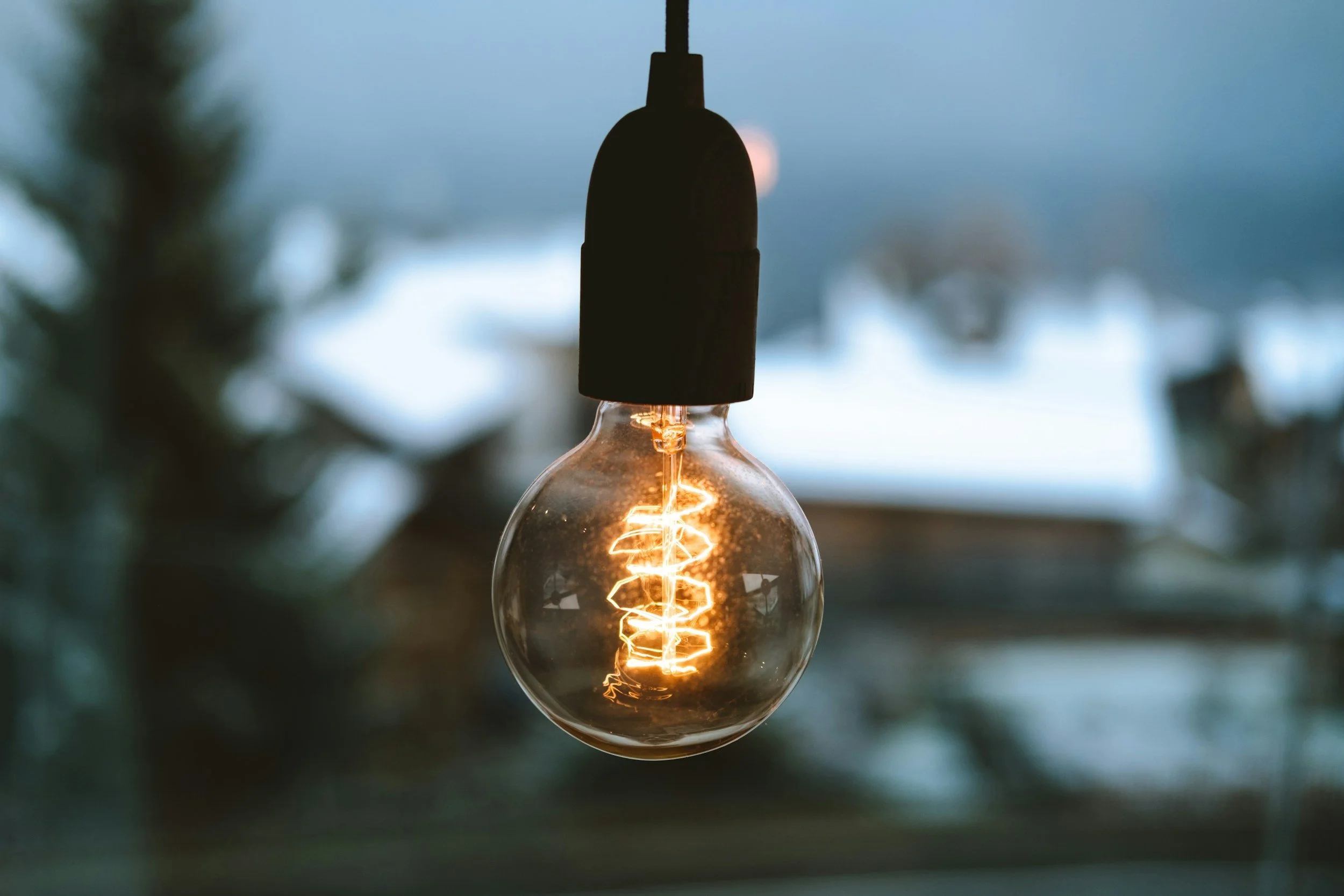
Your brain runs on about 12 watts. That's it—less than a household lightbulb. A large AI system approximating comparable processing draws power on a scale of millions of watts. Researchers have pointed out that the brain can perform roughly an exaflop of computation on about 20 watts, while one of the world's most powerful supercomputers needs a million times more energy to do something similar. Your brain is, quite literally, the most energy-efficient computer we know of, and it does its work while also keeping your heart beating, remembering your brother’s birthday and deciding what to have for dinner.
But the deeper advantage isn't efficiency. It's curation. An AI model processes what it's given. Your unconscious mind is processing eleven million bits of lived, embodied, sensory reality every second—the temperature of the room, the tension in a colleague's voice, the almost-imperceptible flicker of your own worry—and it is constantly, silently deciding what deserves your one, precious, 60-bit spotlight. That filtering isn't a limitation. It's the most sophisticated relevance engine that exists. No model has your nervous system, your history, your particular way of knowing a room has gone quiet in the wrong way.
The best supercomputer was never going to be the one with the most raw throughput. It was always going to be the one that knows what to ignore.
Using this on purpose
None of this is really about impressing anyone with a fun brain fact at dinner (although that’s cool to do!). It's an invitation to treat your attention like the finite, precious resource it actually is. Here’s some simple, practical ways to protect it:
Protect the beam: If you only get 60 bits a second of conscious bandwidth, decide in advance what earns it. Before you open your laptop, name the one thing today that actually deserves shining your light on.
Let the switches cost less: Since every interruption costs roughly 25 minutes of recovery, batch your context switches instead of letting them ambush you. Check messages in windows, not pings.
Trust the quiet knowing: When a decision feels obvious before you can justify it, that's not laziness—that's 11 million bits a second of pattern recognition talking. Give your intuition a seat at the table alongside your spreadsheets.
Build in unlit time: Your unconscious does its best integrative work when your conscious mind steps back—in the shower, on a walk, in the gap right before sleep. Boredom isn't wasted time. It's when the ocean gets to do its work without the lighthouse in the way. (There's a whole other layer to this in the minutes just before you fully wake up—more on that in my next blog post!)
Notice what you're lighting up. Once a day, pause and ask what your beam has actually been pointed at. Not what you meant to focus on, but what you actually did. The gap between those two things is usually the most honest thing you'll learn all day.
We keep looking outward for something faster, smarter, more powerful than us. We feel threatened by the speed and smarts of AI. But the most extraordinary processor most of us will ever encounter is quietly running eleven million calculations a second, right now, behind your own eyes—mostly so you can be gently handed the sixty that matter.
What would you shine your light on today, if you got to choose on purpose?